
Sara Levitt spent 15 years making sure nobody saw her ostomy bag. These days, the celebrated model and social media influencer is known for sharing it with the world.
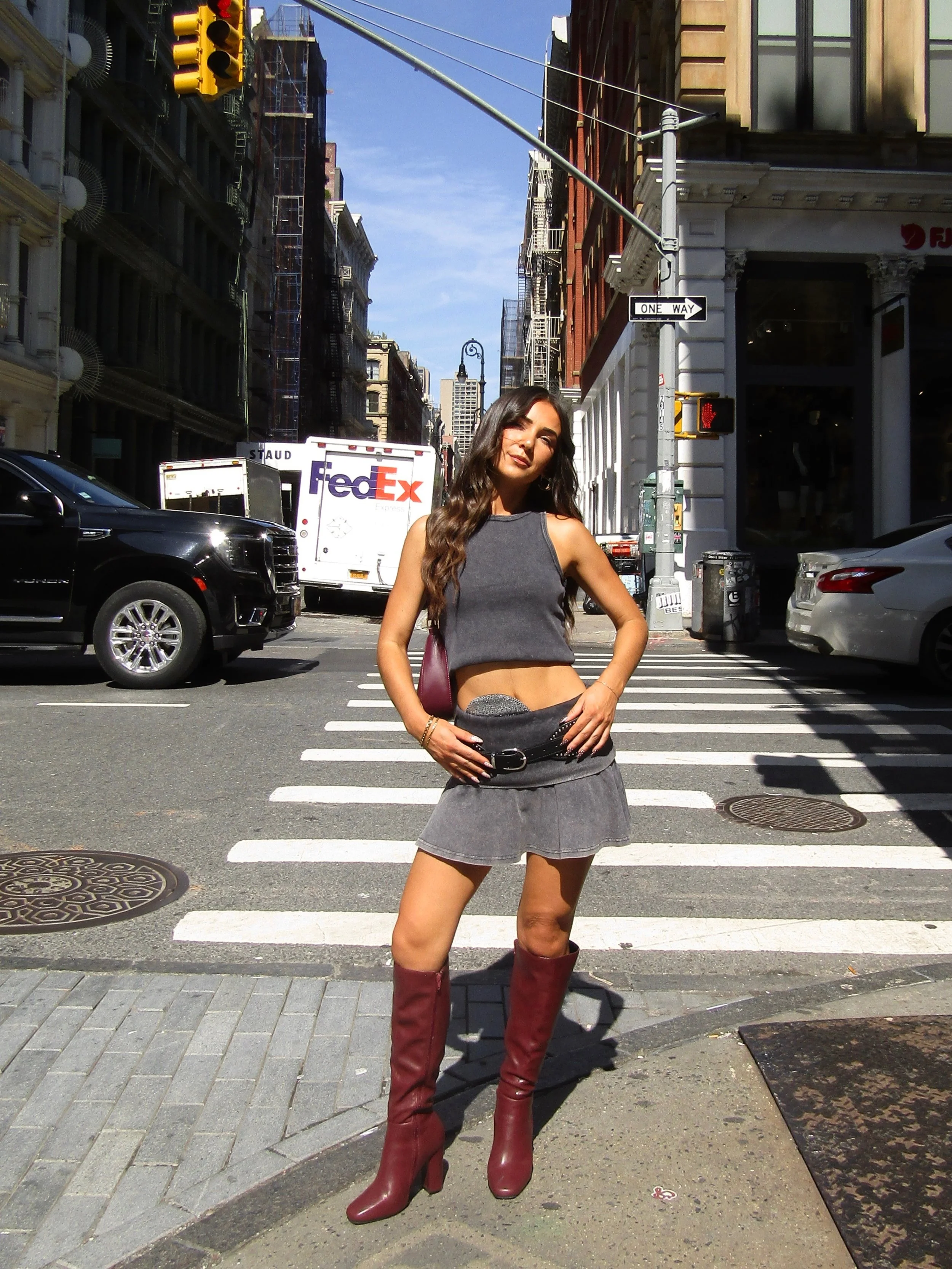
In her teens and early 20s, when Sara Levitt got cosy with some new partners, she’d tell them point blank: “Don’t move my sweater. If you want this to happen, just leave it.”
Under that sweater was Sara’s ostomy bag. A small pouch on her abdomen that, through a surgically created stoma, has been collecting her bodily waste since she was 13.
“I kept my ostomy secret from the majority of the world besides my closest friends, my family and a select number of partners,” Sara tells In Crowd.
“Sometimes I would get intimate with one night stands or casual partners – completely concealing my ostomy and keeping a sweater on, holding my arm around my stomach and saying, ‘I’ve had surgery, I have scars’. And really just living in fear of what others would think of me.”
It wasn’t until she was almost 29, just a couple of years ago, that this Montreal-based model would reveal her whole self. And she did so in a big way.
In 2024, Sara became the first ostomate to grace the pages of Maxim Australia and, the following year, the first contestant to compete in Miss Universe Canada with her ostomy bag on display, strutting her way into the top 15.
Sara and her ostomy bag – which she calls ‘Liv’ – have now walked international runways including New York Fashion and Miami Swim weeks. They’ve also starred in global fashion campaigns for a number of labels. With her story featured across People and Time magazines, Sara has gone from hiding her life-saving device to sharing it with the world, often signing off her social media posts as “a girl with no booty hole”.
“Little me would never have imagined, when she was told ‘you’re gonna go poop in a bag on your stomach for the rest of your life’, what this would amount to,” she says. “I’m grateful that I can be the voice, the hope and the image that little me needed years ago.”
Sara was three years old when she was diagnosed with ulcerative colitis – a chronic bowel disease that causes ulcers and inflammation in the lining of the large intestine. For much of her childhood, her symptoms could be managed with medication. This changed in March 2006 when, at age 11, Sara was diagnosed with severe Crohn’s disease impacting her small and large intestine and her rectum. Two years of lengthy hospital admissions followed as her medical team scrambled to find the right treatment plan.
“I was extremely sick,” says Sara. “I was on a cocktail of IV medication, doing tonnes of exams, ultrasounds, MRIs, CT scans and colonoscopies. I was significantly underweight, not able to eat by mouth and fed by nose tube. I was living with excruciating stomach pain and had zero quality of life.”
While suffering her physical symptoms, Sara also grappled with social stigma.
“Poop is a taboo topic – it shouldn’t be, we all do it – but it’s something we don’t traditionally talk about,” she says. “So already that was playing a massive role in who I was as a person. Like, oh my god, I don’t want to talk about this with any of my friends, but my entire life revolves around it.”
In May 2008, age 13, Sara had emergency colostomy surgery and her first ostomy bag was placed.
“It was the last thing I wanted,” she says. “Even after having just gone through the worst two years of my life, the ostomy felt way worse than that. Life with a bag of poop on my stomach, 24/7, seemed like the worst possible outcome ever.”
Entering her teens, Sara was faced with a list of unknowns.
“Like, who am I now? How am I gonna dress? How am I gonna tell friends? How am I going to go to school? What if it makes a sound? People are gonna think I’m gross, disgusting, that I smell. How am I gonna date? Like, my life is over – this is how I felt,” she says.
At this stage, Sara’s ostomy was only meant to be temporary. Her doctors had left her rectum intact for potential reconnection in the future.
“I held on to that for so long,” she says. “This played a massive role in me wanting to hide and conceal my ostomy from the world, because I was like, well, if I’m gonna have it for like six months, eight months – a year tops – I’ll be fine. I’ll be ‘normal’ again.”
A further four surgeries later, Sara transitioned from a colostomy to a permanent ileostomy.
“So I lost my colon,” she says. “And then, in my early 20s, I had proctectomy surgery – which is permanent and meant saying ‘rest in peace’ to my booty hole. It’s called ‘Barbie butt surgery’ for obvious reasons. No exit, no entry.”
By this point, Sara had hiding her ostomy down to an art. She’d cut nylon stockings into shorts to wear under her clothes and keep it tucked in. As she started wearing more figure-hugging clothes, she’d craft cardboard squares to place on top of her ostomy and hide its circular outline.
“I was like, nobody can know that I have this, this has to be undetectable,” Sara recalls. But once it became lifelong, things started to shift.
“Every challenging conversation I had with a new friend or a guy, trying a new outfit, slowly wearing bikinis, were all small steps to rediscover my self-love, rediscover my confidence and figure out, who is Sara with an ostomy?”
In 2019, Sara had visited Cuba with her family and, for the first time, wore a bikini in public. In 2023, she returned for a solo holiday. “And I felt very different,” she says. “I felt really comfortable and confident in my own skin. And I had reached a point where I was physically and mentally drained of keeping it a secret.”
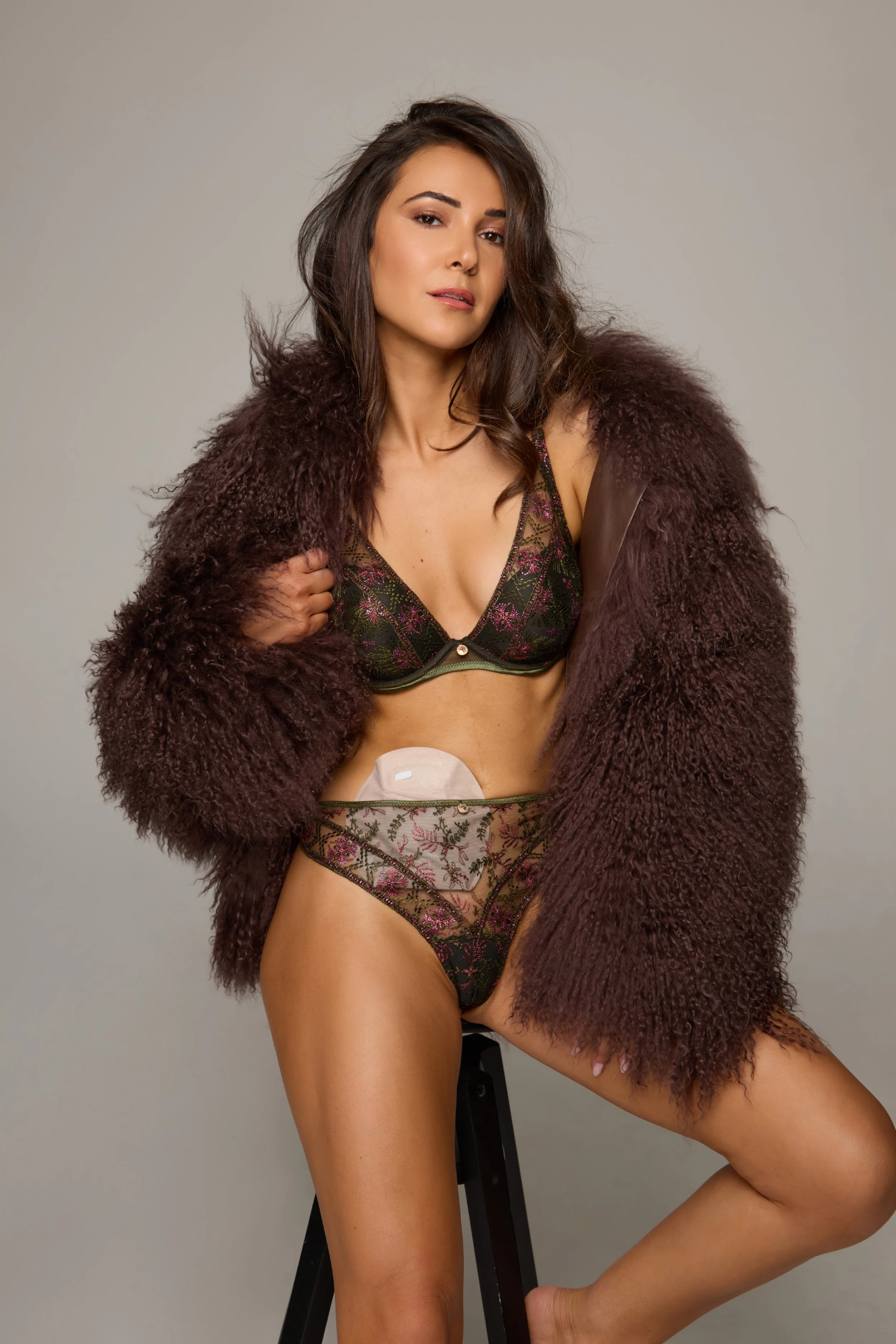
A few months later, on her 29th birthday, Sara’s public advocacy began with a social media post from a campaign she’d shot in Los Angeles with swimwear brand Farago the Label.
“That was the first photo shoot that I’d done where my bag was visible,” she says. “I had no idea what I was doing. Everybody around me was super supportive and engaged, but I was still a little bit shy and nervous – and very cautious about my bag staying flat.”
Sara’s next shoot was with Maxim Australia in Tulum, a coastal town on Mexico’s Caribbean coast. By then, she’d given her ostomy its name, ‘Liv’, which means ‘life’ in Swedish.
“After I had shared my story, I felt liberation and freedom,” says Sara. “I was on a rooftop in a hotel with the sun. I was shooting, I was moving and I felt like my full self because I’d finally embraced my ostomy. It was out there and I wasn’t scared. I was doing this because I wanted to show it.”
This experience pushed Sara to leave her corporate marketing career and pursue better representation of people like her in fashion and media.
“I wasn’t doing social media. I wasn’t modelling. This was all new to me,” she says. “But I thought, if I can do this, which other brands can I work with to create ostomy content, and fight for diversity and normalisation, and de-stigmatise this?”
Today, Sara’s portfolio makes ostomies look right at home in luxury fashions and dreamy destinations. But amid the beachside snaps and five-star service, she shares a steady stream of reality.
“Having poop drip down your leg – that is a part of ostomy life,” she laughs. “Situations like that can pick away at your confidence, but you need to feel those feelings and you need to grow through it. Yes, you can live a completely normal, fulfilled life with lots of sparkles. But it’s a constant, adapting journey.”
Sara’s style has also evolved. One of the first brands she worked with was Peppermayo Australia. As she scrolled their collection, she caught herself thinking, ‘I can’t wear that’. But then she challenged herself, choosing a matching low-waisted jean and denim top set.
“I was looking at it and thinking, this is so flipping cute. I would never wear this, but I’m getting it and I’m gonna do it,” she says. “I wore it on a date with a guy that I was seeing at that time and we went to a sushi restaurant.”
And here is where the girl with no booty hole said goodbye to the girl in the sweatshirt.
“I remember walking to the restaurant being like, oh my god, everybody’s probably staring at me right now. But I felt in control. I felt empowered. I felt like I wasn’t hiding it – like it was just there. I’m showing up like I am, you see all of me – and this is it.