
Read This if You’re Thinking of Getting a MACE or Chait
Three things In Crowd editor Anja Christoffersen wishes she knew before getting an appendicostomy.

Going to the toilet is something you take for granted, until it doesn’t work properly.
My whole life, I’ve dealt with slow-transit constipation. Nine months ago, in an effort to address this 28-year struggle, I had surgery to create a stoma that enables me to flush out my bowels from the start of my large colon.
There are many terms you may encounter when researching this type of bowel management: MACE (Malone Antegrade Continence Enema), ACE, Malone, appendicostomy and cecostomy, as well as various catheter names – such as Chait, or MiniACE – depending on the type of procedure or device used.
Before my stoma surgery (a MACE procedure, where I had a Chait tube placed), I’d tried several other strategies: rectal enemas, high-volume rectal irrigation (think of it as an at-home, daily colonic), laxatives, other prokinetics, diet, addressing ‘lifestyle factors’ and even sometimes eating expired, warm dairy products to elicit a bowel movement. A little food poisoning was an acceptable risk, but often even that would not work!
When I made the decision to get this stoma, almost as a ‘stepping stone’ before ending up with a permanent ileostomy, I was quite clueless about the reality. It’s difficult to find data on how many adults live with these kinds of interventions, particularly in Australia. Most of the information I found was focused on children.
While planning for this surgery with my medical team, I’d asked a lot of important questions, but still ended up adjusting to something I didn’t feel prepared for.
If I knew what it would be like before I got it, I wouldn’t have gone ahead with it. But now, I couldn’t imagine my life without it. Both things are true at once.
In the spirit of getting some information out there for adult Australians considering surgical bowel management – and for clinicians supporting us through this decision – here is what I wish I’d known:
You need to prepare for gaps in support
This surgery represents fantastic medical advancement, but the support system around it hasn’t necessarily caught up.
At times, I’ve questioned whether we’ve built enough support around Australian adults being offered this surgery when awareness of it can be limited even within colorectal care – let alone other specialties. Surgery creates an access point, but you’re the person responsible for learning to manage it day to day.
If you end up at your GP, with a team outside of your regular hospital or in ED, you’ll likely encounter clinicians who have never managed this kind of stoma before. And if someone doesn’t know what’s normal, it can be difficult to recognise what isn’t.
This has been my experience and I’ve heard similar stories from other adults living with a MACE – but I don’t want to deter people from having this surgery, or to criticise our overstretched healthcare workforce. Rather, I’m hoping to share that having this surgery means you have to take responsibility in advocating for what you need – even when you may not know what that is.
Here are some tips:
Before surgery, find out who your contact will be and what supplies you will need.
Before surgery or very soon after, organise any forms for submission for financial support with your stoma supplies. You can learn more about what's available here.
Ask your colorectal surgeon or stoma team to write a brief letter explaining what your MACE is, who ED clinicians can contact, what to do in common scenarios and which symptoms require urgent assessment. Keep it somewhere accessible and ask for a version to give to your GP.
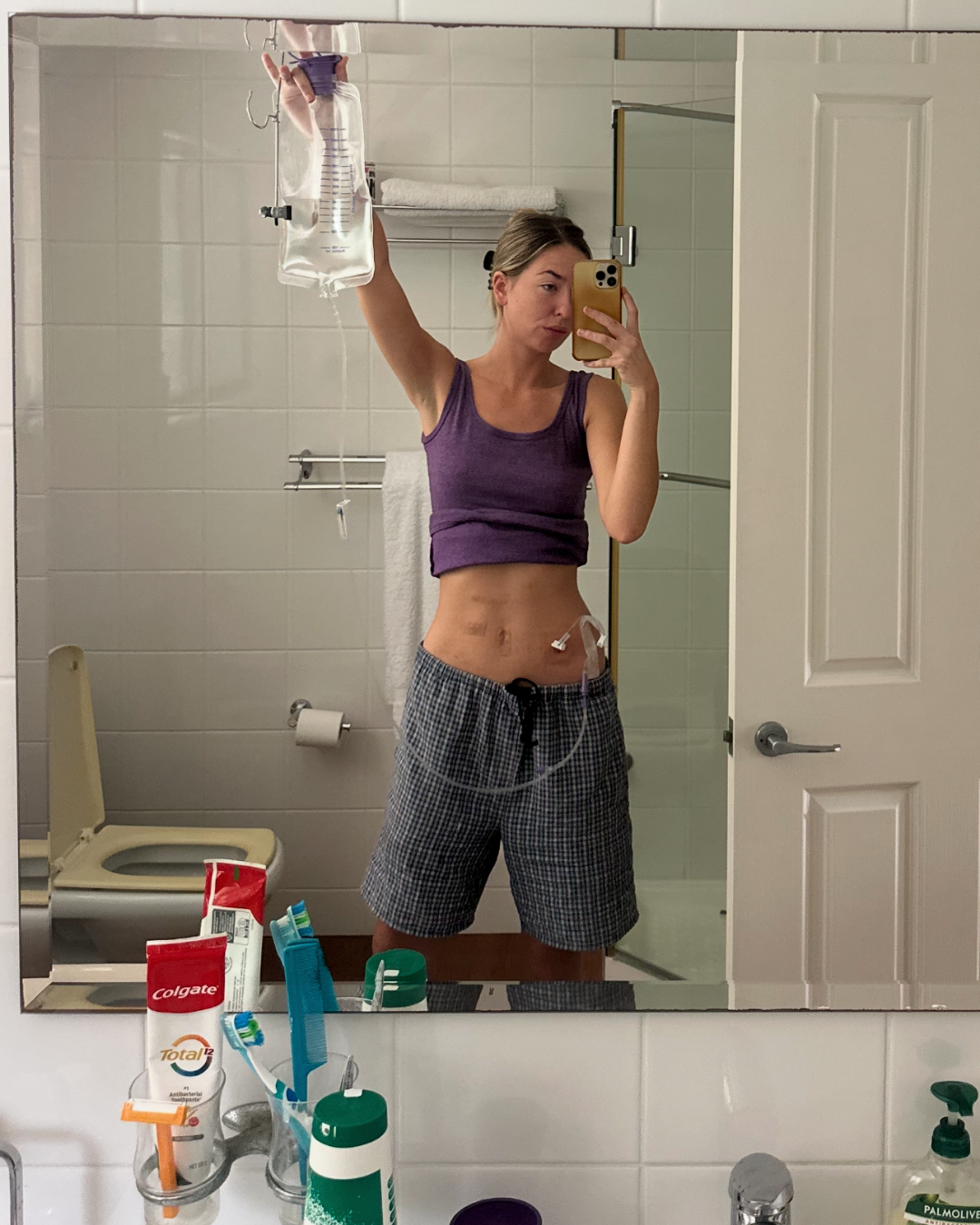
It doesn’t always work how you expect it to
It takes time to heal from this surgery, so don’t expect to be doing the full flushes straight away. I had to do 10ml flushes to stop the tube clogging from day one, but wasn’t able to do a full flush until almost a month in.
My first flush worked perfectly and, after the complications I’d had, I was over the moon. I began to feel like it was worth it, but that joy didn’t last long.
In theory, you put a mixture into your gravity-feed bag, it goes into your colon and the mixture and poo all come out your bum. In practice, this process can be very hit and miss.
As we did more flushes, a group of us living with these tubes – my 'Chait chat' girls – started comparing notes and found that, sometimes:
You can do a flush and none of the mixture or stool will come out… ever?
The mixture will come out without any stool, looking the same as it went in.
Stool and the mixture will shoot out of your MACE.
There will be delays, like you think nothing will happen and then suddenly four-plus hours later it does…
What works one day won’t work the next.
This flushing thing is more of an art than a science. When it doesn’t work, it’s frustrating as hell. When it does, it’s a godsend and you’d never want to live without it.

It gives you another option, not a solution
If you approach a MACE expecting it to cure your slow motility, you may be expecting it to do something it was never designed for. Rather than seeing it as a solution, I’d view it for what it is – another way to help your bowel empty.
If you’ve lived with slow-transit or chronic constipation, you’ll know that sometimes laxatives or enemas work, and sometimes they don’t. The effectiveness varies and is unpredictable. A MACE is no different.
In the same way you’d change up your laxative type or amount when it is ineffective, be prepared to be doing that with your flushes. There are a lot of variables that you and your treating team may end up adjusting when you’re trying to find a routine that works, such as:
How often you are flushing.
The mixture you are using to flush (like just water, or water and a laxative).
The volume of flush.
The speed of the flush.
The time of day you do the flush (sometimes consistency of time establishes a routine for your body, or you may find it works better to do after eating).
Trying a syringe flush before your gravity feed.
Your hydration levels – if you’re dehydrated your bowel will absorb the fluid fast, my stoma nurse told me that adding salt to the water helps to slow reabsorption.
I have tried many variants and can promise you that, eventually, something works. And when that stops working, something new will start working.
When my flushes work, it gives me something none of the previous options could – a way to empty my very uncooperative bowel. It’s been the difference between spending days feeling like the bloat would finally bust me open or drinking litres upon litres of bowel prep, and finding relief within an hour so I can get on with life.
Perhaps the biggest thing I wish I’d understood before surgery is that a MACE comes with a mental load, and asks much more of you than a bowel flush. It does provide you with another trick up your sleeve to clear your bowels, but it requires the same adaptability I’d built from living with a bowel that doesn’t follow the instruction manual.