
How a mishap at the shops led Michelle Hobson to turn years of medical dismissal into a community helping others navigate life with IBD.
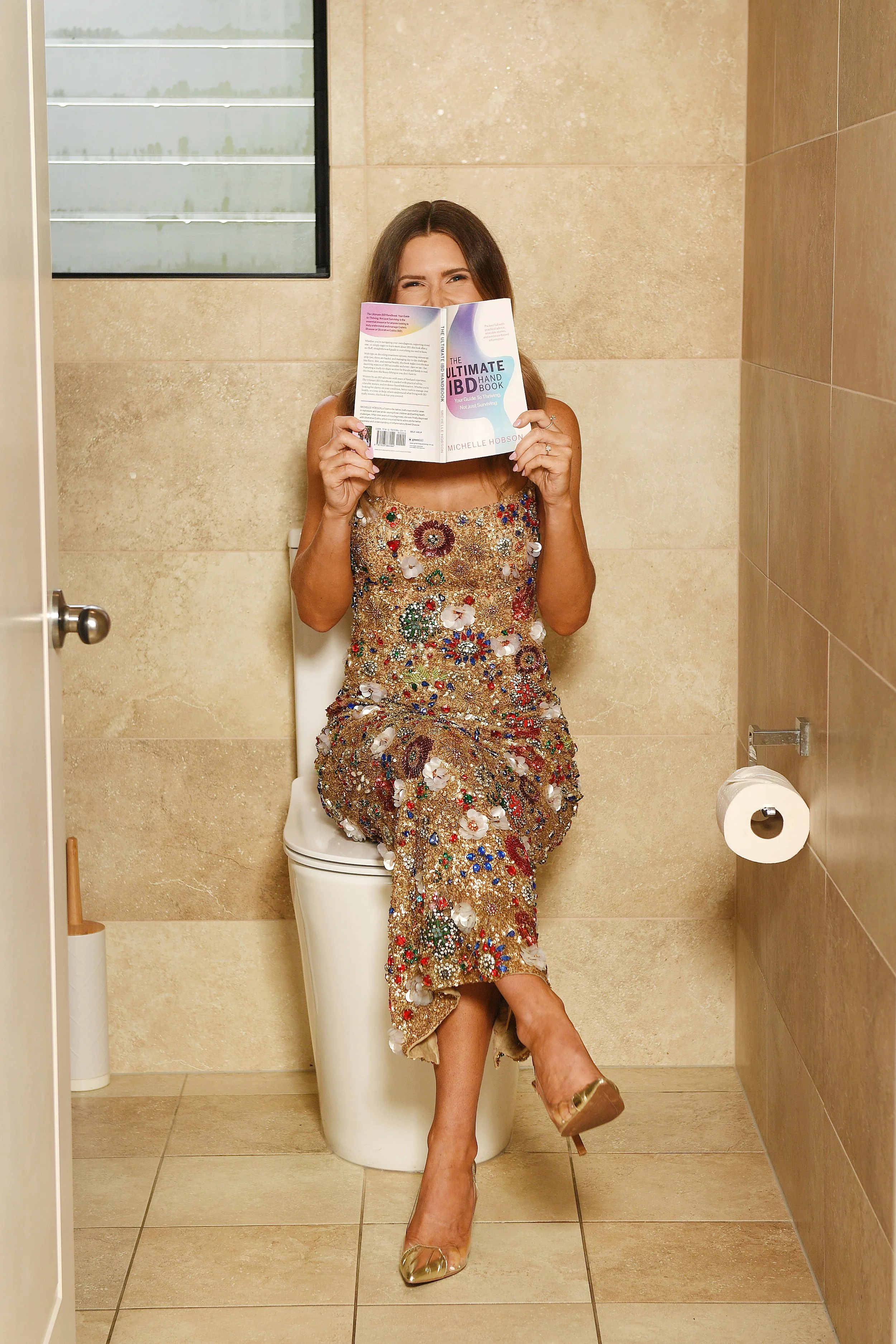
Michelle Hobson wasn’t in hospital when she hit her lowest point. She was pushing a trolley through the freezer aisle.
“I knew instantly I was not going to make it [to the bathroom]. I left the trolley, walked out calmly pretending everything was fine, got into my car and just sobbed,” Michelle tells In Crowd. “I went home and threw my clothes in the bin because I could not even bring myself to wash them with the family laundry.”
Despite experiencing harrowing hospitalisations, she says it was this moment – having an accident in Woolworths – that broke her.
“That was the moment I realised how small my world had become. My entire life revolved around toilets, fear and shame.”
Michelle began wearing adult nappies to do the school run. On top of the weight of her bowel urgency, the mother of two carried feelings of shame and disgust, and felt as though she was hiding a secret no one could find out.
“It wears you down emotionally because you stop feeling like yourself. You aren’t just sick, you are grieving the person you used to be.”
In 2016, when Michelle was in her twenties and had just had her second child, everyone dismissed her exhaustion as a normal part of parenting young kids. Deep down, Michelle suspected something was wrong.
“My stomach constantly felt swollen and tight. I was getting sharp cramping pain, [bowel] urgency and exhaustion that did not feel normal,” Michelle explains. “Then came the blood [in my stools]. Weight loss. Waking up in sweats. Vomiting. I became terrified of being too far from a toilet.”
Hiding these symptoms became incredibly hard for a woman who once took pride in having never so much as farted in front of her partner.
For the next seven years, as Michelle sought answers, she was met with dismissal that slowly eroded her trust in herself.
“For years I was told it was stress, anxiety, hormones, IBS or something I was eating. I became obsessed with trying to ‘fix’ myself,” Michelle shares. “I tried every diet imaginable because I genuinely thought maybe I was causing my own illness.”
Despite her efforts, worsening pain, vomiting, weight loss and blood in her stool repeatedly sent her back to emergency departments. She would receive IV fluids, pain relief and be sent home with advice to “manage her IBS”.
“When you are repeatedly dismissed, you start questioning your own reality. I genuinely reached a point where I did not know how I was going to keep living my life like that,” she shares.
“The hardest part was that the people you believe are there to help you sometimes do not. I had always trusted medical professionals completely… so when I kept being told everything was fine while my health was clearly deteriorating, it broke something in me.”
By 2023, years of unanswered symptoms had caught up with her.
“I had been severely unwell for days and eventually collapsed at home while changing my son’s nappy. I went to hospital, showed photos of the blood and symptoms I had been documenting and was still sent home being told it was probably a UTI [urinary tract infection] and gastro,” Michelle says.
“Less than a day later I collapsed again and came back by ambulance. This time they scoped me and found severe ulcerative colitis immediately. I remember this strange mix of fear and relief because finally, after years of feeling dismissed, there was proof that I was not imagining it. I was critically unwell and spent 12 days in hospital.”
Finally diagnosed, Michelle lay awake in her hospital bed at 2am, scrolling through Facebook support groups, attempting to make sense of what had just happened to her. Medical information she found online either felt too clinical or too “woo-woo”.
“None of it really resonated with me. I was exhausted, terrified and trying to process a life-changing diagnosis, yet everything felt hard to understand or disconnected from real life,” Michelle shares.
“I remember asking if there was someone I could talk to about the diagnosis, like a counsellor or support person. It was another waitlist. I asked about seeing a dietitian… another waitlist.”
Ulcerative colitis, which falls under the umbrella of Inflammatory Bowel Disease (IBD), impacts 10 million people worldwide.
“I started reading other people’s stories in the online groups and realised how many had come frighteningly close to death before finally being diagnosed,” says Michelle. “There were so many people who had been dismissed, minimised or told it was anxiety before eventually discovering they had severe IBD.”
Even with her diagnosis, Michelle, like many others she connected with online, wasn’t getting the clarity, resources and support she needed.
“I started collating information and sharing it back into the groups because I was desperately trying to make sense of it all myself. Eventually that turned into writing The Ultimate IBD Handbook, because I wanted people to have access to information that is evidence-based but actually understandable.”
There wasn’t just an information gap, but a divide between the work of clinicians and online influencers.
“The [clinical] organisations are incredible for evidence-based information, research and medical resources,” Michelle explains. “Then you have influencers who are amazing at making people feel seen and understood through lived experience. But I remember thinking, ‘Where is the in-between?’”
Michelle decided to build a space that complements organisations, respects the science and encourages people to listen to their doctors and specialists, while also talking honestly about the everyday reality of living with IBD. This blossomed into IBD Hub.
Today, this “sh*t-talking, stigma-breaking, no-filter” platform reaches hundreds of thousands of people through education, advocacy and peer support.
“I wanted people to still go to the organisations for their medical information and to their doctors and specialists for treatment plans, but I wanted IBD Hub to become the everyday support network in between all of that. The place that talks about the school runs, relationships, accidents, parenting, anxiety and all the little day-to-day things that medical brochures don’t really prepare you for,” she says.
“I started getting messages from people saying things like, ‘I thought I was the only one who carried spare clothes in my car,’ or ‘I’ve never told anyone this before’,” Michelle reflects. “That was when I realised just how many people were quietly carrying this disease alone.”
With organisations like IBD Hub, the landscape is changing for this community.
“Years ago, people barely even wanted to say the word ‘bowel’ out loud. Everything felt embarrassing and hidden,” says Michelle. “Now we are seeing landmarks across Australia light up purple for World IBD Day, hospitals supporting awareness campaigns and more people openly speaking about invisible illness.”
Michelle’s proudest moments are the ones that are unseen – the messages she receives from people who have booked their first colonoscopy, peers with IBD of all ages, their parents and partners.
Her advocacy has recently taken her in an unexpected new direction: running in her local government by-election.
“It probably sounds a little crazy, but in a strange way my diagnosis and everything that has come with it played a big part in deciding to run,” she says.
“My most recent surgery had quite a few complications, and coming out the other side of that really cemented this attitude of: if I can get through that, I can get through anything. Life is short, so do the things you’ve always wanted to do and don’t look back.”
Today, Michelle still lives with ulcerative colitis. But the woman who abandoned her trolley in a Woolworths freezer aisle now helps thousands of Australians feel less alone.
For Michelle, that’s a reality she never could have imagined.
“For so long I thought ulcerative colitis had ruined my life. In a strange way, it actually gave me one I am incredibly proud of.”